
Learning to draw is an exciting journey, but many beginners feel frustrated in the early stages because their drawings do not match what they imagine. The biggest reason for this challenge is that most beginners skip the basic practice that builds strong drawing skills. Instead of focusing only on finished artwork, artists should spend time practicing essential techniques that improve observation, control, and understanding of shapes.
This is why drawing exercises for beginners are extremely important. These exercises help train your hand, improve your ability to observe details, and build confidence in your drawing process. Just like athletes practice drills to improve performance, artists practice drawing exercises to strengthen their visual and technical skills.
Professional artists understand that improvement in drawing does not happen overnight. It happens through consistent practice and learning how to see objects more clearly. By practicing simple exercises regularly, beginners can gradually develop the skills required to draw more complex subjects such as portraits, landscapes, and realistic sketches.
In this guide, we will explore the best drawing exercises for beginners that help develop strong fundamentals and make learning drawing easier. These exercises are simple, practical, and suitable for students, hobby artists, and anyone interested in improving their artistic abilities.
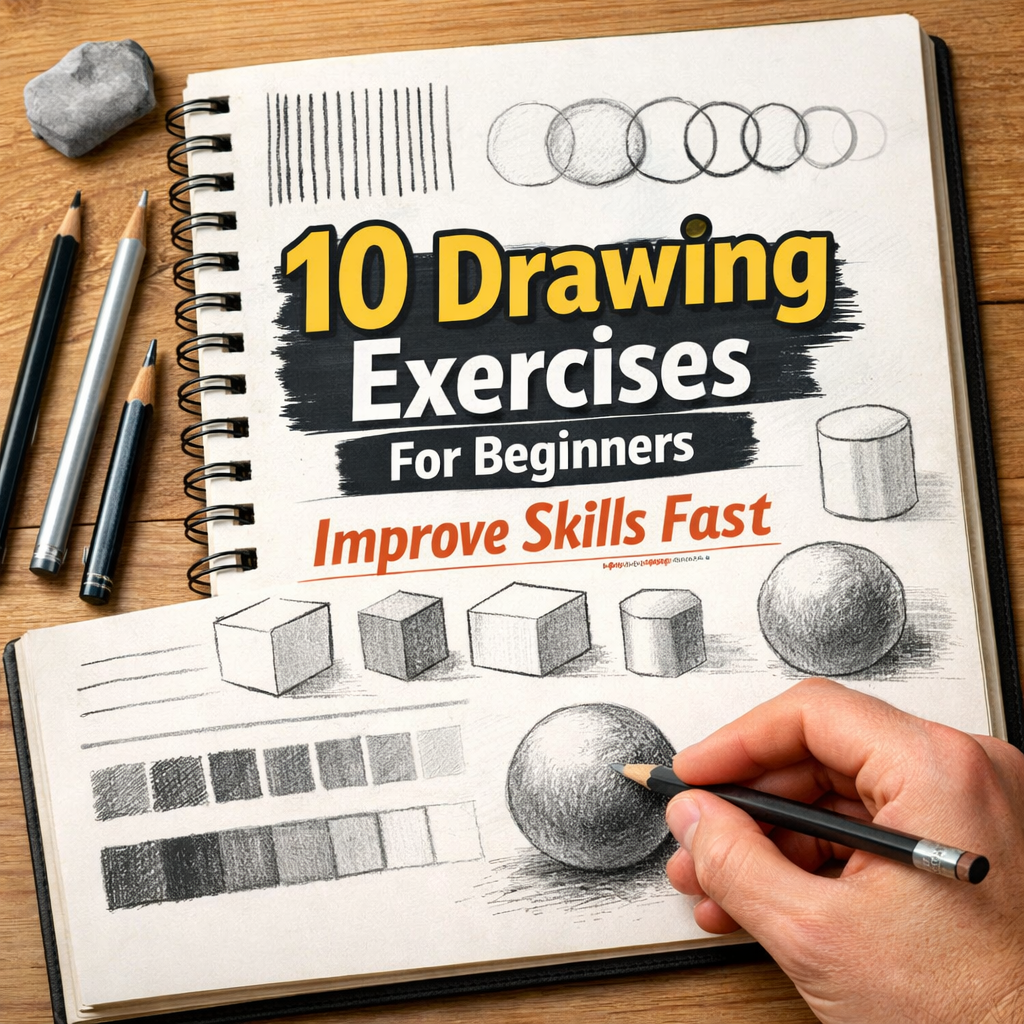
Understanding the Importance of Drawing Practice
Drawing exercises for beginners are not only about talent; they are primarily about training your eyes and hands to work together. These drawing exercises for beginners help artists build coordination, observation skills, and control over lines and shapes. When beginners practice regularly, their brain gradually learns how to translate visual information into accurate lines and shapes on paper, which leads to steady improvement in drawing skills.
There are three important skills every beginner artist must develop:
- Observation – seeing shapes, proportions, and details accurately
- Hand control – moving the pencil smoothly and confidently
- Understanding structure – recognizing how objects are built from basic shapes
Practicing structured drawing exercises for beginners strengthens these abilities and helps artists create more accurate and expressive drawings.
Table of Contents
Why Drawing Exercises Are Important for Beginners
Many beginners try to draw complex subjects immediately, such as portraits or detailed scenes. Without practicing the fundamentals, this often leads to frustration and slow progress. This is where drawing exercises for beginners become extremely important. These drawing exercises for beginners help artists develop essential skills like hand control, observation, and understanding of basic shapes. By practicing these exercises regularly, beginners can build a strong artistic foundation and improve their drawing skills step by step.
Drawing exercises help beginners build strong foundations in several ways.
Improves Hand Coordination
Repeated line and shape exercises train your hand to move more steadily and accurately.
Develops Observation Skills
Practicing drawing from real objects improves your ability to notice shapes, angles, and proportions.
Builds Confidence
As beginners practice simple exercises, they gradually gain confidence and become more comfortable with drawing.
Strengthens Artistic Fundamentals
Strong basics make it easier to learn advanced techniques like shading, perspective, and composition.
This is why practicing drawing exercises for beginners regularly is essential for artistic growth.
10 Best Drawing Exercises for Beginners
1. Straight Line Practice
Line control is the foundation of drawing. Begin by practicing straight lines across a page without using a ruler.
- Horizontal lines
- Vertical lines
- Diagonal lines
- Curved lines
This simple exercise improves pencil control and helps artists develop steady hand movements.
2. Basic Shape Drawing
Every complex object can be simplified into basic shapes. Practice drawing shapes such as circles, squares, cubes, cylinders, and spheres.
Understanding these shapes helps artists construct objects more accurately.
3. Contour Drawing
Contour drawing focuses on the outline of an object. Choose a simple object like a cup, shoe, or leaf and carefully draw its outline while observing the object closely.
This exercise improves observation skills and accuracy.
4. Gesture Drawing
Gesture drawing captures the movement and overall form of a subject quickly. Set a timer for one minute and sketch the basic shape of a subject.
This helps beginners draw more freely and develop fluid lines.
5. Shading Practice
Shading is important for creating depth and realism. Beginners should practice techniques such as hatching, cross-hatching, and blending.
Try shading simple shapes like spheres and cubes to understand how light interacts with surfaces.
6. Negative Space Drawing
Negative space refers to the empty space around objects. Instead of drawing the object itself, draw the shapes around it.
This exercise helps artists understand proportions and spatial relationships.
7. Observation Drawing
Observation drawing means drawing real-life objects while studying them carefully. Good beginner subjects include fruits, plants, bottles, or books.
This exercise improves accuracy and visual awareness.
8. Texture Practice
Textures add realism to drawings. Practice drawing textures like wood, stone, fabric, and leaves.
Studying textures helps artists capture details more effectively.
9. Perspective Drawing
Perspective helps create depth in drawings. Beginners can start with one-point perspective by drawing simple objects such as roads, buildings, or boxes.
This exercise teaches spatial relationships and visual depth.
10. Daily Sketching
Keeping a sketchbook and drawing daily is one of the most powerful drawing exercises for beginners. Even short daily sketches can significantly improve drawing ability over time.
Common Mistakes Beginners Make
Many beginners face challenges because they make certain common mistakes during practice. Without proper guidance and structured drawing exercises for beginners, learners often struggle to improve their line control, proportions, and observation skills. Practicing the right drawing exercises for beginners helps artists identify these mistakes early and correct them through consistent training and repetition.
- Skipping basic exercises and trying complex drawings too soon
- Practicing inconsistently
- Erasing frequently instead of learning from mistakes
- Not observing real objects carefully
Avoiding these mistakes can help beginners improve faster and enjoy the learning process.
Building a Daily Drawing Routine
Creating a daily routine helps beginners stay consistent. A simple practice routine might include:
- 5 minutes line practice
- 10 minutes shape drawing
- 10 minutes observation drawing
- 5 minutes quick sketching
Following this routine regularly strengthens drawing fundamentals and builds artistic confidence.
Simple Drawing Tools for Beginners
Beginners do not need expensive art supplies to start drawing. Basic tools are enough for practicing exercises.
- HB pencil
- 2B pencil
- Sketchbook
- Eraser
- Sharpener
Using simple tools allows beginners to focus more on practicing drawing exercises for beginners rather than worrying about materials.
Why Choose Flairs Smartclass
Flairs Smartclass provides structured fine art training designed to help students develop strong drawing fundamentals. Our programs include carefully designed drawing exercises for beginners that help students build observation skills, line control, and understanding of shapes. Through step-by-step guidance and regular practice, these drawing exercises for beginners allow students to progress from basic drawing skills to more advanced techniques with confidence.
- Structured drawing courses
- Professional artist mentors
- Practical exercises and assignments
- Skill development from beginner to advanced level
This approach helps students build confidence and develop real artistic abilities.

About Flairs Smartclass
Flairs Smartclass is a fine art and skill development institute dedicated to teaching drawing, painting, and creative skills through structured training programs designed for students and aspiring artists.
About Artist Mentors
Our artist mentors are experienced professionals who guide students step by step in learning drawing fundamentals, observation techniques, shading methods, and creative thinking.
Conclusion
Learning to draw is a gradual process that develops through patience, regular practice, and the right learning approach. Many beginners feel discouraged when their drawings do not immediately look the way they imagined, but this is a completely natural part of the artistic journey. Every skilled artist once started with simple sketches and drawing exercises for beginners before developing advanced artistic abilities.
Practicing structured drawing exercises for beginners plays a key role in building strong artistic foundations. Exercises such as line practice, basic shape drawing, observation sketches, and shading drills train both the eyes and hands to work together more effectively and improve overall drawing accuracy.
Consistency is one of the most powerful factors in improving drawing skills. Even practicing for a short period each day can lead to noticeable progress. Maintaining a sketchbook and regularly practicing drawing exercises for beginners helps artists develop discipline, improve hand control, and track their progress over time.
To summarize the key ideas discussed in this guide about drawing exercises for beginners, here are some important points every beginner artist should remember:
- Practice drawing regularly, even if it is only for a short time each day.
- Focus on mastering basic drawing exercises before attempting complex artwork.
- Train your observation skills by drawing objects from real life.
- Use simple shapes to construct more complicated subjects.
- Maintain a sketchbook to track your progress and practice consistently.
- Study light and shadow to improve shading and depth in your drawings.
- Avoid comparing your work with others and focus on personal improvement.
- Be patient with your progress and accept mistakes as part of learning.
- Experiment with different drawing exercises to build a wide range of skills.
- Enjoy the creative process and keep exploring new artistic ideas.
With dedication, curiosity, and consistent practice, anyone can develop strong drawing abilities. Over time, these foundational practices open the door to more advanced techniques and creative exploration.
Frequently Asked Questions
What are the best drawing exercises for beginners?
Line practice, shape drawing, shading exercises, gesture drawing, and daily sketching are some of the most effective exercises.
How often should beginners practice drawing?
Beginners should practice drawing at least 20–30 minutes daily for steady improvement.
Can drawing skills improve with practice?
Yes. Drawing is a learnable skill that improves through consistent practice.
What should beginners draw first?
Beginners should start with simple shapes and basic objects before moving to complex subjects.
How long does it take to improve drawing skills?
With consistent practice, beginners usually start noticing improvement within a few weeks.